Celebrating 15 Years of Lunch and Learn +65 8644 0645

Category: Featured

  • Happy Labor Day

    Happy Labor Day

    To Everyone who is …
    working hard and hardworking. Enjoy this very special day with your love ones!

  • Jigsaw@work : Difficult Conversations

    Jigsaw@work : Difficult Conversations

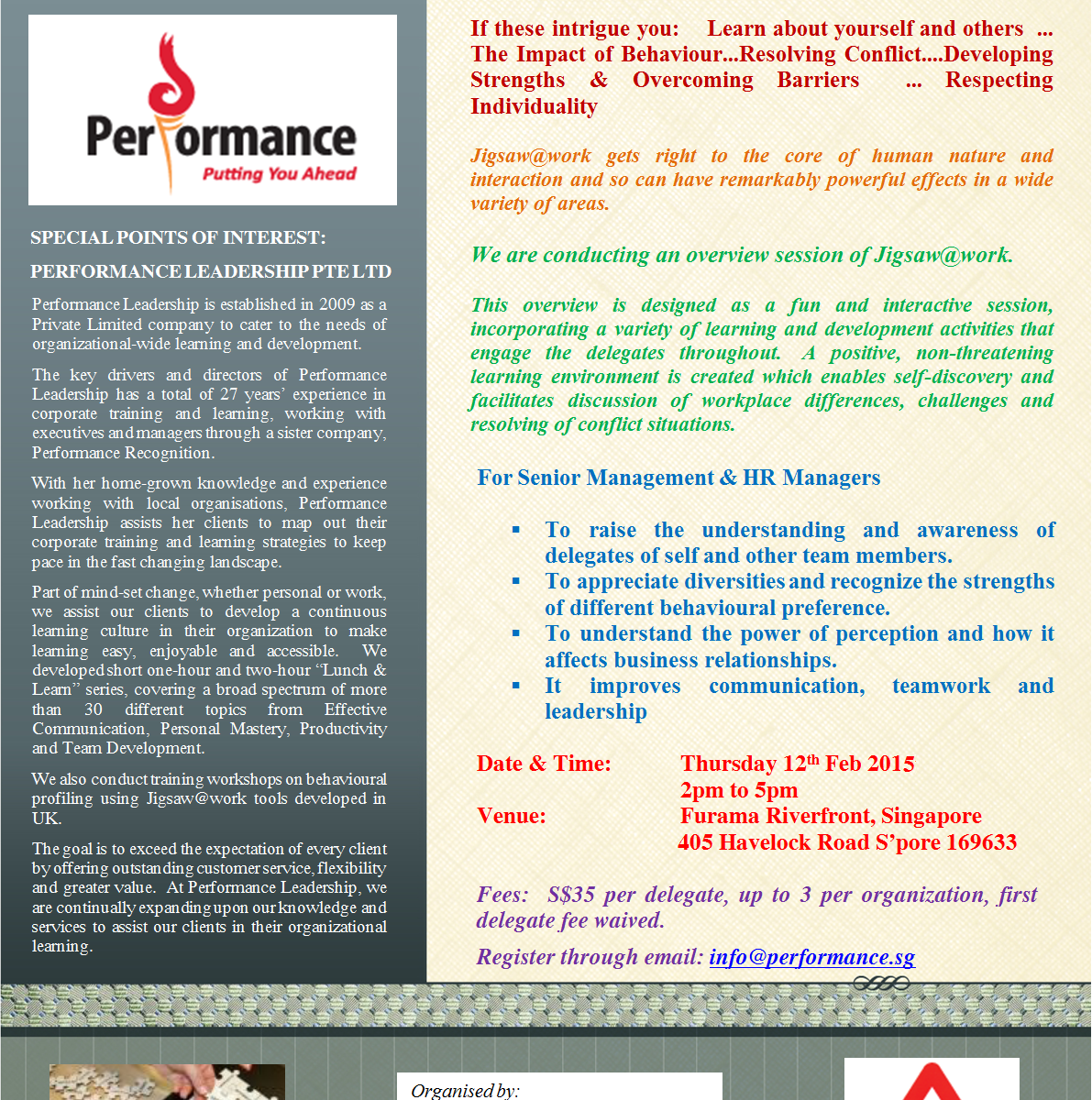
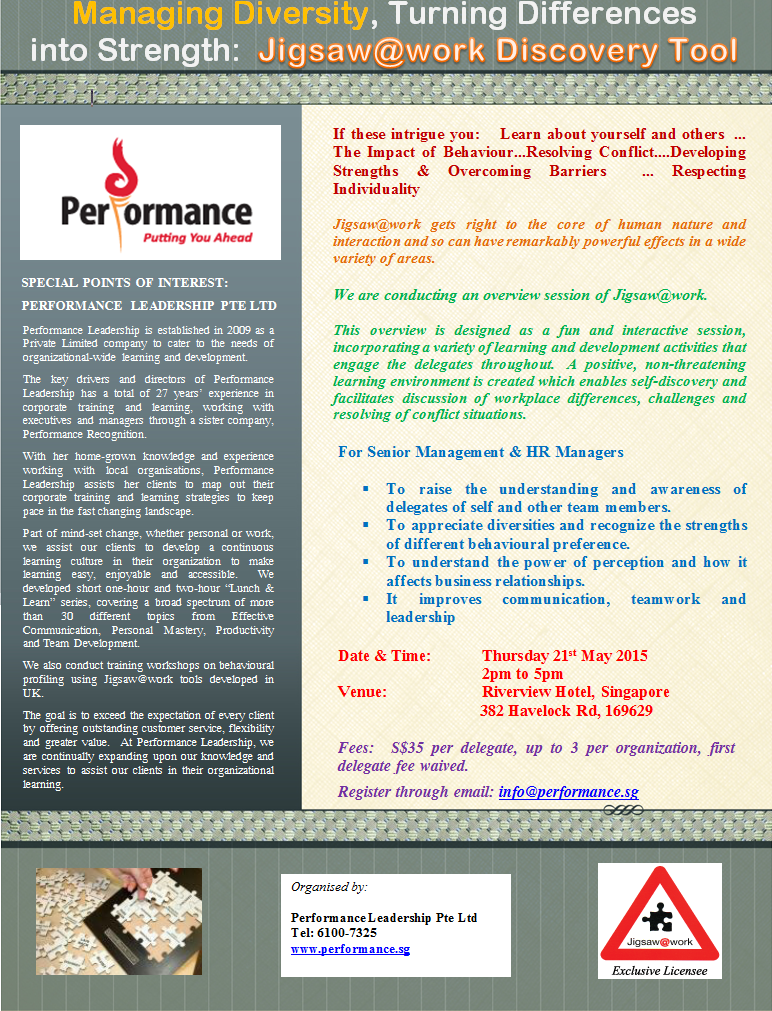
    Difficult Conversations : Getting The Message Across

    Date : 12 Feb 2015, Thursday
    Time : 2 – 5 pm
    Venue : Furama Riverfront, Singapore

    Please refer to below for more details of this event.

  • There’s no “i” in “team,” but there is an “i” in “mistake”

    A survey of 1,000 business people found that 83% of respondents feel ”very confident” or “confident” in their ability to make the right business decisions. Conversely, a 19-year study by an Ohio State professor found that 53% of all business decisions are bad ones.

    So what’s the one word that can explain this stark difference between perception and reality? According to a Scripps Howard News Service article, that one word is “ego.”

    This research claimed that, “nearly one-third of all decisions are driven by ego.”

  • How to Improve Strategic Thinking?

    Want to improve your strategic thinking? Prepare to be offended, says Forbes article

    “How do you improve your thought process?” asked a November 9, 2010 article in Forbes magazine. The question is, “simple but worth thinking about.”

    The article continues that leaders can improve their strategic thinking in as little as 15 minutes per day by reading or soliciting the viewpoints of people who conflict with, or are even offensive, to their own opinions.

    “One of the worst things managers can do is always think they are right,” warns the article. “It’s dangerous to read the work of people who agree with you and surround yourself with yes men.”

    How do you improve your thought process? Question your own thinking and surround yourself with people who think you’re nuts…and who aren’t afraid to tell you.

  • Inspiring your team

    “DOING A GOOD JOB HERE IS LIKE WETTING YOUR PANTS IN A DARK SUIT. YOU GET A WARM FEELING, BUT NO ONE ELSE NOTICES.”

    Does this quote above describe your company, department or job function? Is this how your employees feel?

    This was a sign posted on the wall of a fundraising office of a major university, where annual turnover exceeds 400%. In an average three-month period, the entire staff quits, causing hiring and training costs to skyrocket.

    This was also an example shared in a June 2011 article of The Harvard Business Review titled “How Customers Can Rally Your Troops.”

    “A growing body of research shows that end users – customers, clients, patients, and others who benefit from a company’s products and services – are surprisingly effective in motivating people to work harder, smarter, and more productively,” claims the article. “Outsourcing inspiration is not about eliminating leaders from the picture; it’s about creating a partnership that can enhance the meaning employees derive from their jobs and move them to do their best work.”

  • 25 April 2012

    ” Do common management techniques such as setting targets and monitoring performance actually help companies become more productive and profitable?” asked a groundbreaking McKinsey & Co.  study profiled in the Sept. 8, 2008 edition of The Wall Street Journal. After examining 4,000 midsize factories in 12 countries, researchers answered this question with a huge “yes.

  • 23 April 2012

    Recently, The Wall Street Journal asked executive learning students to rate the importance of classmate quality as a factor in choosing an executive education program. Over 78% of respondents said classmate quality is very important. In fact, when asked to rate their classmates’ positive contribution to the learning experience on a scale of 1 to 10, the median score was 8.4.

  • 18 March 2012

    “Companies face an increasingly complex world…Today companies, on average, set themselves six times as many performance requirements as they did in 1955, the year the Fortune 500 list was created…Companies clearly need a way of managing complexity.”

    – Harvard Business Review,  Sept 2011

  • 15 Feb 12

    In a recent survey, 30% of respondents said that people today are inherently dishonest. 65% of respondents believed that people are less honest than people were 25 years ago. If you read or watch the news on any given day, you’d probably be inclined to agree with them.

    Even if you don’t speak Spanish (especially if you don’t speak Spanish), see if you can identify the ability of this Coca-Cola commercial from Peru to rise above the limits of the spoken word and deliver a positive message about the world and the delightful people in it. The name of this commercial is “La Billetera de la Felicidad,” or “The Wallet of Happiness.”

    As part of an experiment in a very crowded Lima district in Peru, Coke deliberately left a wallet containing $100 to try to test people’s honesty. 70% of people passed the test. Not only that, their honesty drove them to incredibly great lengths just to do the right thing.

    Whenever humanly possible, we need to see – and celebrate – our employees and the people around us in the same way.

  • 1 Feb 12

    An article appearing in the April 25, 2010 edition of The Times of India shares that mentoring and training are at the heart of India’s emergence as a global center of innovation and R&D.

    “Training is a continuous process, not just in technical issues but also in management skills, quality consciousness, communications, foreign language and personal-effectiveness skills,” shares the article. “Mentoring by senior executives is another key Indian practice.”

    The article explains that in 2002, India had 102,000 engineering graduates. Within four years, that number had rocketed to 222,000, and that mark is expected to double this year. To understand how a country could grow so many skilled people in such a short period of time, Duke and Harvard Universities sent research teams to study this phenomenon. What they discovered was that Indian companies first learned best practices of Western companies operating in India. Then, the Indians innovated and improved on that learning and reinforced it with mentoring.

    “Many companies virtually became universities, employing hundreds of trainers,” shared the article. One example of this is an Infosys training center in Mysore which trains 13,500 employees at once.

    “Employees get reviewed at the end of every project and are prescribed training if found to have weaknesses,” write the authors of this article. “Mechanisms such as 360-degree reviews (wherein you review your bosses and peers) and balanced scorecard reviews are widely used. Managers are evaluated on a variety of non-financial measures, including employee satisfaction, attrition rates and mentoring.”